
The November 2026 core update is still rolling out, and the honest answer for a small site is: wait, check the two reporting traps first, and change nothing yet. Google started the rollout on 10 November 2026, says it may take up to two weeks, and has given no fixed end date — so on 23 November the update is still moving, and no verdict about your rankings is safe before about 1 December. This guide works through the update in order: what Google actually said, the two traps that make November's numbers lie, what our own Search Console shows, and the five things worth doing while you wait.

1. What the November 2026 core update is — and what it is not
A core update is a broad change to how Google ranks pages. It is not aimed at any one site, any one page, or any one trick. Google describes this one as a regular update designed to better surface relevant, satisfying content — the same kind of broad reassessment it runs several times a year. It is not a penalty. A penalty is a specific action against a site for breaking a rule, and it comes with a notice in Search Console; a core update comes with a dashboard entry and no notice, because nothing was done wrong.
That distinction matters because it decides the response. A penalty means finding what broke the rule and fixing it. A core update means the ranking of pages is being re-weighed against each other, and the only durable response is better pages — not a fix applied in a panic during the rollout. Google's own standing advice for core updates is the same every time: a ranking drop during one does not necessarily mean anything is wrong with your pages.
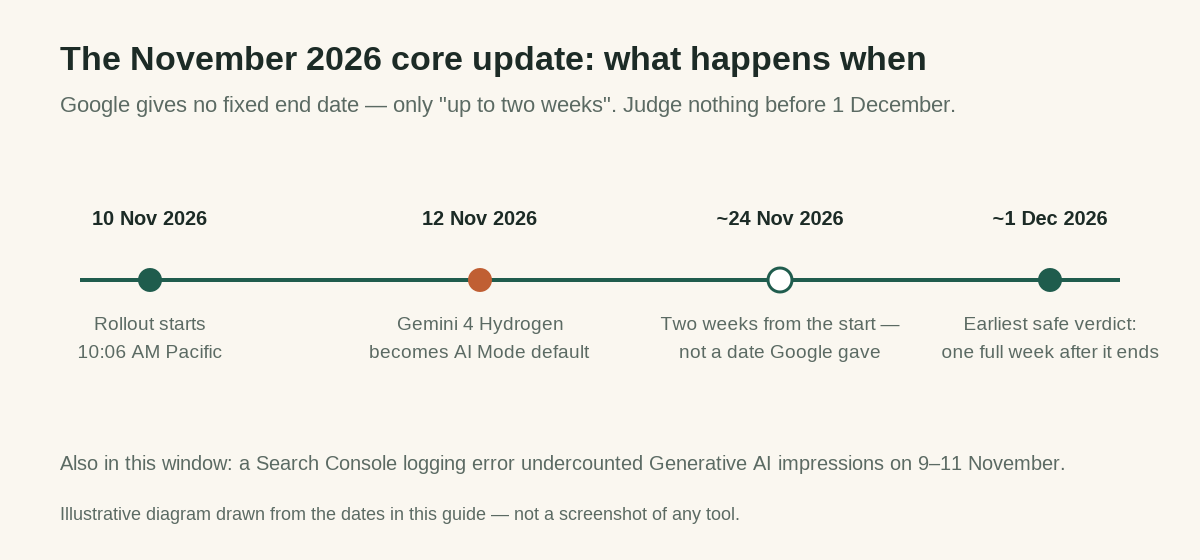
The update applies globally and to all languages. It began on 10 November 2026 at 10:06 AM Pacific, and the Google Search Status Dashboard lists it as Active on 23 November, with the line: "Released the November 2026 core update, which applies globally and to all languages. The rollout may take up to 2 weeks to complete." Two weeks from 10 November points to about 24 November — but that date is arithmetic, not something Google said. Google has given no fixed end date, and the dashboard had posted no completion notice by 23 November.
2. The timeline at a glance
| Date | What happened | What it does to your numbers |
|---|---|---|
| 31 Oct – 2 Nov 2026 | Search Console click spike on some sites | Clicks jump, impressions flat — automated clicks, not people |
| 9 – 11 Nov 2026 | Logging error in the Generative AI report | AI impressions undercounted for three days — a reporting gap, not lost visibility |
| 10 Nov 2026 | November 2026 core update starts | Rankings keep shifting until the rollout ends |
| 12 Nov 2026 | Gemini 4 Hydrogen becomes the AI Mode default | AI answers change; ranking and citation shifts may come from this, not the update |
| ~24 Nov 2026 | Two weeks from the start | The latest Google allows for the rollout — not a date Google gave |
| ~1 Dec 2026 | Earliest safe verdict | At least one full week after the rollout ends |
Three separate events landed in the same two weeks: a bot click spike, a logging error, and a new AI model — plus the core update itself. That is why November's numbers need reading in order, not at face value.
3. How shaky were the rankings? Read the trackers carefully
Semrush Sensor, which scores how much Google's results change day to day, read about 9.4 out of 10 for US desktop searches on 12 November 2026 — its "Very High" band. That sounds like the update shaking everything. The honest reading is narrower: the Sensor had already been sitting at about 9.4 since around 27 October, two weeks before Google announced anything, and it stayed almost flat through the announcement. Some of that movement came before the update, and some of it may come from problems collecting accurate results. A high tracker number proves the results were moving; it does not prove this update moved them, and it says nothing about your site.
The trackers measure a fixed set of keywords, not your pages. Your own Search Console is the only measurement that describes your site, and section 7 below shows what ours actually says — with the same caution applied to it.
4. Trap 1: the click spike that was not people (31 October – 2 November)
At the start of November, a number of sites opened Search Console and found their clicks had suddenly doubled, or more, while impressions stayed flat. SEO consultant Marie Haynes dug into the data and published the findings in Search Engine Journal on 5 November 2026. On the three properties she monitors, clicks jumped 2x to 6.5x against the previous seven days — one site went from about 50 clicks a day to 327 on 2 November — while impressions and average position barely moved.
The shape gives it away. The extra clicks landed mostly on desktop, while mobile clicks stayed normal. They landed on pages ranking in positions 11 to 55 — pages two to six of the results, which normally get almost no clicks — at click-through rates of 45% to 100%. Many queries logged exactly one impression and one click. Real searchers do not behave like that: almost all real clicks go to the top few results on page one.
Haynes is careful not to claim certainty about the cause. The likely explanations are scrapers or automated browsers clicking through deep results to copy page content, click-manipulation networks, AI agents opening lots of results to extract answers, or a gap in Google's filtering — Google normally strips known automated clicks out of Search Console before you see them, and some may have slipped through. Google has not confirmed a cause. What is established is the pattern: it was not human traffic, and it was not the core update either — it happened a week before the update started.
How to check your own numbers: in the Performance report, filter by Device: Mobile. If mobile clicks look normal through early November while the overall line spikes, the spike was the automated traffic. Compare clicks against orders, sessions and product views for the same days too — real visitors leave a trail on the site; automated clicks do not.
5. Trap 2: the Generative AI report undercounted impressions (9 – 11 November)
The second trap overlaps the update itself. Google's Search Console data anomalies page carries this entry: "A logging error caused a decrease in impressions on the Generative AI performance report in Search for data from November 9 – November 11, 2026. This issue affects data logging only." The Generative AI report is the part of Search Console that shows how a site appears in AI Overviews and AI Mode. For those three days, it recorded fewer impressions than really happened. The pages kept appearing in AI features as usual; the report just did not count all of them.
Two limits matter. First, the error touches only that one report — it does not explain a drop in the main Performance report. Second, Google has not said whether the missing data will be restored, or when. So if your AI impressions dipped on 9, 10 or 11 November, do not rewrite pages over it: those three days say nothing about your pages. Exclude them from any week-on-week comparison, and check the report's own annotation on those dates before drawing any conclusion.
There is a third event in the same window, and it is real, not a trap: on 12 November, Google made Gemini 4 Hydrogen the default model in AI Mode for all users worldwide, and uses it for the hardest questions in AI Overviews. It also widens query fan-out, so each AI Mode answer draws on a broader range of linked sites. Ranking and citation shifts this month may come from the model change, from the core update, or from both — and no report separates the two. That is one more reason not to attribute a single change to a single cause while both are still moving.
6. What our own Search Console shows — the worked example
This is our own site, veltrixcode.com, read fresh in Search Console on 23 November 2026. Nothing here is a case study of success; the site is small, young, and barely visible in search, which is exactly why it is a useful example — it shows what "too early to judge" looks like in real numbers.
Over the last 28 days (25 October – 20 November 2026): 14 clicks, 15,464 impressions, average position 58.8, average click-through rate 0.1%. Over the last 7 days (15 – 21 November 2026): 7 clicks, 12,747 impressions, average position 56.3, average click-through rate 0.1%. Two things stand out. First, 12,747 of the 28-day total of 15,464 impressions — more than four in five — arrived in the last seven days, the week the core update was rolling out. Second, clicks did not follow: 7 clicks in that week, against 14 in the whole 28 days. At an average position of 56 to 59, the site sits mostly on pages five and six of the results, where almost nobody clicks — so a surge in impressions with almost no clicks is what a site at this position looks like, not evidence of a win or a loss.
The honest reading is that these numbers cannot support a verdict either way. Fourteen clicks in 28 days is too little to measure a change in, the 7-day window sits inside an unfinished rollout, and the 9–11 November logging error sits inside the same period. The pages report, last updated 16 November, says 124 pages indexed and 56 not indexed — the top reasons are pages with redirects (19), alternative pages with a proper canonical tag (11), and duplicates where Google chose a different canonical than the site (9), then soft 404s (7), crawled but not indexed (5), not found (2), discovered but not indexed (2), and duplicates without a user-selected canonical (1). None of those is a core-update injury; they are the ordinary housekeeping of a small site, and they are the list to work through while waiting — not a reason to panic.
Write your own numbers down the same way before you change anything: the 28-day and 7-day clicks, impressions and average position, from the same property, on the same day. Then put the pen down until December. If you want to know what each of those four numbers actually means, read the SEO report metrics explained guide — it reads this same report, number by number, and shows which ones flatter and which ones decide. A baseline taken during a rollout is a baseline of a moving target.

7. November 2026 core update small business checklist: what to do while it rolls out
Do the work in this November 2026 core update small business checklist — it is useful regardless of what the update decides — and leave the judging until December. In order:
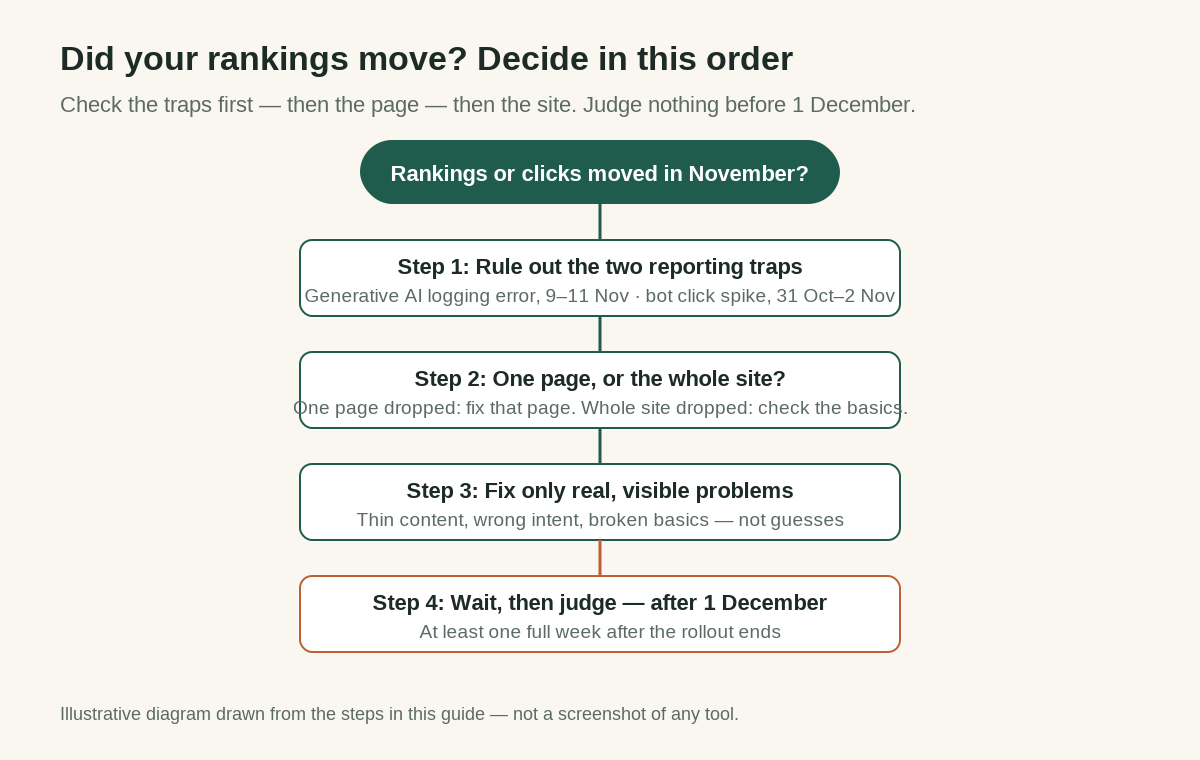
- Rule out the two traps. Check the 31 October – 2 November click spike (desktop vs mobile) and the 9 – 11 November Generative AI logging error before believing any November dip. If your "drop" is one of those, there is nothing to fix.
- Ask whether it is one page or the whole site. One page dropping points at that page — its content, its intent match, its title. The whole site dropping at once points at the basics, or at the update itself, which you cannot fix by editing. Do not rewrite ten pages because one moved.
- Fix only real, visible problems. Thin content, a page that answers a different question than the search asks, a title that never names the topic, a broken page, a slow page on a phone. If you cannot point at the problem on the page, you have not found a problem — you have found a ranking, and rankings move during a rollout.
- Run your key pages through a checker. Section 8 below runs our own free on-page checker on a real page and shows what a real gap looks like. Do the same for your five most important pages and write down what it finds.
- Keep publishing, and keep a note of what changed. Note the date, the page, and what you changed, in one place. When December comes, you will know what you did during the rollout and what was already true before it — and you will not be guessing.
8. The worked check: our own homepage through the on-page checker
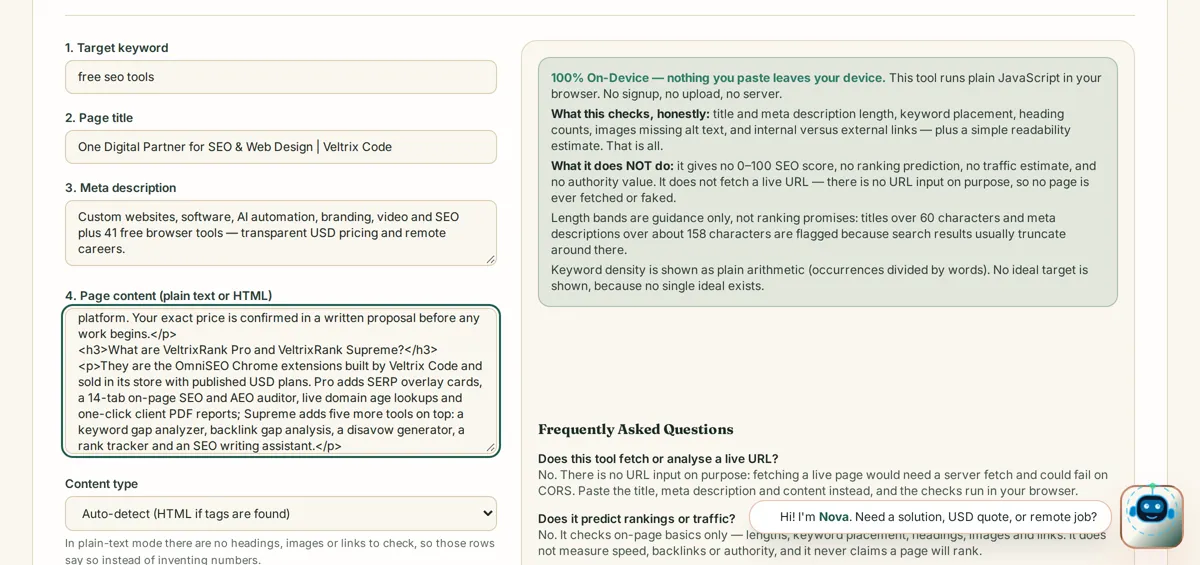
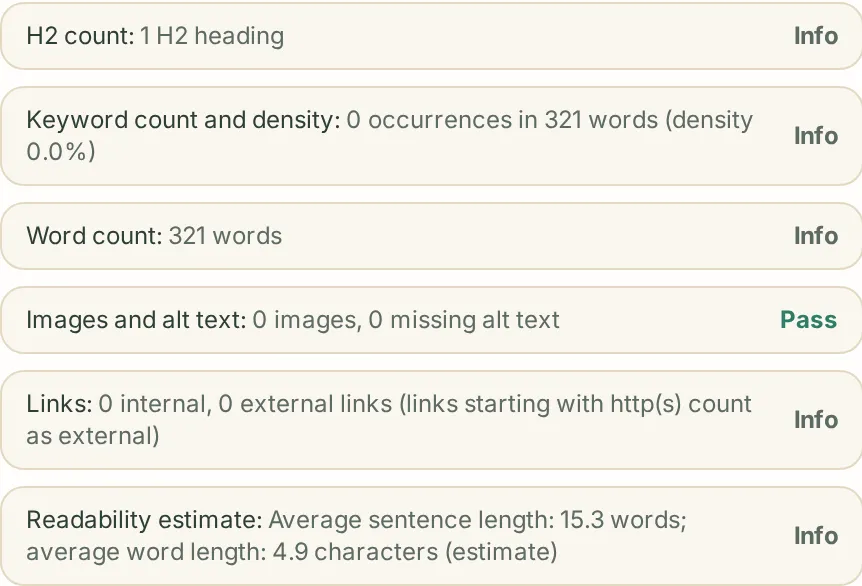
The worked demonstration runs our own free on-page checker on a real page: the homepage of this site, veltrixcode.com. One thing to know about the tool first: it does not fetch a live URL — there is no URL input on purpose. You paste the target keyword, the page title, the meta description and the page content, and the checks run in your browser. So the run below used the target keyword "free seo tools", the real homepage title "One Digital Partner for SEO & Web Design | Veltrix Code", the real meta description, and the homepage's real visible text pasted as HTML. The screenshots are the tool's real output on that input, not a mock-up.
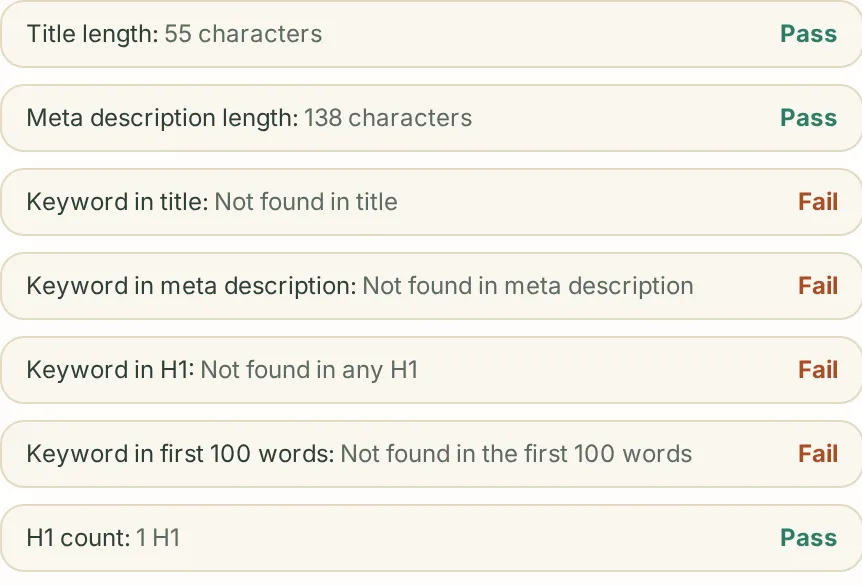
First, the title and meta findings. The result was 4 of 8 checks passed — and the failures are exactly the gap this step teaches. The title is 55 characters, a pass on length, and the meta description is 138 characters, also a pass. But the keyword "free seo tools" appears nowhere in the title, nowhere in the meta description, nowhere in the H1, and nowhere in the first 100 words: "Not found" in all four. A homepage that never says "free seo tools" anywhere search looks cannot rank for "free seo tools", however good the tools are.
Then the headings and the counts: one H1, which passes, and one H2 heading. The keyword count is 0 occurrences in 321 words — a density of 0.0%. Two rows need a careful reading, not a headline: the images row (0 images, 0 missing alt text) and the links row (0 internal, 0 external) reflect only the HTML that was pasted in, not a crawl of the whole homepage, so they are not evidence about the real site's images or links. The heading, title and keyword rows, though, reflect the real homepage content — and they show a real site whose homepage does not name its own keyword where search looks. That is a real, fixable gap, and it is the kind of work a rollout week is for: the page, not the algorithm, is the thing to fix.
Run the same check on your own pages. The on-page SEO checker is free, runs in the browser with no upload, and reports what it found on the page — title, meta, headings, images and links. Compare its answers with what you intended the page to say; where they disagree, the page is the thing to fix, not the tool. Our earlier guide, how to do an on-page SEO audit in 30 minutes, covers the full content side of the same check.
9. What not to do while it rolls out
- Do not rewrite pages because a number moved. Rankings move during a rollout by design. Rewriting a good page mid-rollout teaches you nothing, because you cannot tell whether the next move came from your edit or from the update.
- Do not delete pages that dropped. A page that dropped during a core update may recover when the rollout settles. Deleting it removes the recovery too, and the URL, the links and the history with it.
- Do not buy links, traffic or "recovery" services. Nothing for sale can undo a core update, and a burst of bought links during a rollout is a new problem, not a fix for the old one.
- Do not chase the trackers. Semrush Sensor, and every tracker like it, measures a fixed keyword set, not your site. A 9.4 on a tracker is not a 9.4 on your pages.
- Do not judge on one day's numbers. A single day during a rollout is noise. The comparison that means anything is a full week after the rollout ends, against a full week before it started.
10. When to judge — after 1 December
Google's guidance is to wait until the rollout completes, then at least one full week, before judging Search Console data. The rollout started 10 November and may take up to two weeks, so the earliest a verdict is safe is about 1 December 2026. When that week comes, compare like with like: a full week after the rollout ended, against a full week before it started, in the same report, excluding 31 October – 2 November and 9 – 11 November from both sides.
Judge by the right numbers. For a small site, the numbers that matter are clicks on the pages that earn them, and the queries that bring them — not impressions at position 58, and not a tracker score. If a page lost clicks and the page is thin, or answers the wrong question, or never names its topic in the title, fix the page. If a page lost clicks and the page is genuinely the best answer to its search, leave it alone and keep publishing. And if nothing changed at all, that is also an answer: the update re-weighed the results, and your pages held their place.
The technical SEO checklist for small business sites covers the basics to check before December — crawl access, one URL per page, speed, meaning, dead ends, and a final tool run. A site that clears those six checks has removed the avoidable reasons for a drop, and whatever is left is the update's judgement of the content, not of the plumbing.
11. Common mistakes
- Reading the click spike as growth. A 2x–6.5x jump in clicks with flat impressions in early November was automated traffic, not customers. Celebrating it, or reporting it upward, is how a fake win becomes a real decision.
- Reading the AI report dip as a penalty. The Generative AI report undercounted impressions on 9–11 November because of a logging error. It was a reporting gap, not lost visibility.
- Blaming one event for everything. November held a bot spike, a logging error, a model change and a core update. A single dip can have four parents, and the report does not say which one.
- Fixing the wrong page. One page dropping means that page; the whole site dropping means the basics or the update. Rewriting the whole site for one page's drop wastes the week and muddies the December comparison.
- Judging during the rollout. A verdict taken while rankings are still moving is a guess with numbers attached. Wait until at least a full week after it ends — about 1 December.
- Trusting a tracker over your own data. A 9.4 on Semrush Sensor describes a keyword set, not your site. Your Search Console, read on the same day each week, is the only number that is about you.
Frequently asked questions
Is the November 2026 core update a penalty? No. It is a regular core update, designed to better surface relevant, satisfying content. A penalty is a specific action against a site for breaking a rule, and it comes with a notice in Search Console. This update came with a dashboard entry and no notice, and it applies globally to all languages.
When will the November 2026 core update finish? Google says the rollout may take up to two weeks from 10 November 2026, which points to about 24 November — but Google has given no fixed end date, and the Search Status Dashboard still listed it as Active on 23 November. Check the dashboard, not a rumour, for the completion notice.
Should I change my content while the update rolls out? Change only real, visible problems — thin content, a wrong intent match, a title that never names the topic, a broken or slow page. Do not rewrite good pages because a number moved, and do not delete pages that dropped. Wait until the rollout ends, then judge.
Why did my clicks spike at the start of November? Between 31 October and 2 November 2026, some sites saw Search Console clicks jump 2x to 6.5x while impressions stayed flat. Marie Haynes' analysis in Search Engine Journal (5 November 2026) found the clicks landed on pages ranking in positions 11 to 55, mostly on desktop, at click-through rates of 45% to 100% — the pattern of automated traffic, not people. Google has not confirmed a cause.
Why did my AI impressions drop on 9–11 November? Google confirmed a logging error that undercounted impressions in the Search Console Generative AI performance report for 9–11 November 2026, and said it affects data logging only. Your pages kept appearing in AI Overviews and AI Mode; the report just did not count all of them. Google has not said whether the missing data will be restored.
When can I judge whether my site was hit? At least one full week after the rollout completes — so no verdict before about 1 December 2026. Compare a full week after it ended with a full week before it started, in the same report, leaving out 31 October – 2 November and 9 – 11 November.
Sources
- Google Search Status Dashboard — November 2026 core update incident (status Active on 23 November 2026; began 10 November 2026, 10:06 AM Pacific; "The rollout may take up to 2 weeks to complete"). https://status.search.google.com/incidents/WLxcJyC6jMWMfryxsKMc
- Google Search Console, data anomalies page — logging error in the Generative AI performance report, 9–11 November 2026 ("This issue affects data logging only"). https://support.google.com/webmasters/answer/6211453
- Marie Haynes, Search Engine Journal, 5 November 2026 — Search Console click spikes of 2x–6.5x on 31 October – 2 November, and why they look automated. https://www.searchenginejournal.com/november-click-spikes-in-google-search-console-are-bot-traffic-how-to-filter-your-reports/595834/
- Search Engine Journal, 12 November 2026 — Gemini 4 Hydrogen becomes the default model in AI Mode. https://www.searchenginejournal.com/google-gemini-4-hydrogen-default-ai-mode/597096/
- Semrush Sensor — US desktop volatility about 9.4 out of 10 ("Very High") on 12 November 2026, already near 9.4 since about 27 October. https://www.semrush.com/sensor/
- Google Search Console, veltrixcode.com property — performance read 23 November 2026: 28 days (25 October – 20 November) 14 clicks, 15,464 impressions, average position 58.8; 7 days (15 – 21 November) 7 clicks, 12,747 impressions, average position 56.3; pages 124 indexed, 56 not indexed (last update 16 November).
- Veltrix Code, technical SEO checklist for small business sites — the six basics checks to run before December. https://veltrixcode.com/blog/technical-seo-checklist-small-sites/
- Veltrix Code, local SEO checklist — the measurement section this post's retro-link comes from. https://veltrixcode.com/blog/local-seo-checklist/
- Veltrix Code, on-page SEO audit in 30 minutes — the content side of the checker run in section 8. https://veltrixcode.com/blog/on-page-seo-audit-checklist/
Where to start this week
This November 2026 core update small business guide comes down to one habit: write down your numbers first — the 28-day and 7-day clicks, impressions and average position from your own Search Console, on the same day — and check the two traps before believing any November dip. Then compare the free rank trackers, ours included, and watch your keywords daily while the update settles: a rank tracker shows which of your pages actually moved, day by day, instead of a single Search Console line that mixes a bot spike, a logging error and a rollout into one shape. The free on-page checker runs the same check as section 8 on any page you paste in — title, meta, headings, images and links, in your browser, with no upload.