
AEO stands for answer engine optimization: the work of getting your brand named or cited inside an answer written by an AI system, such as ChatGPT, Perplexity, or Google's AI Overviews. SEO earns your page a position in a list of links. AEO earns your brand a place inside the answer itself — as a linked citation, or as a name the answer recommends without a link at all.
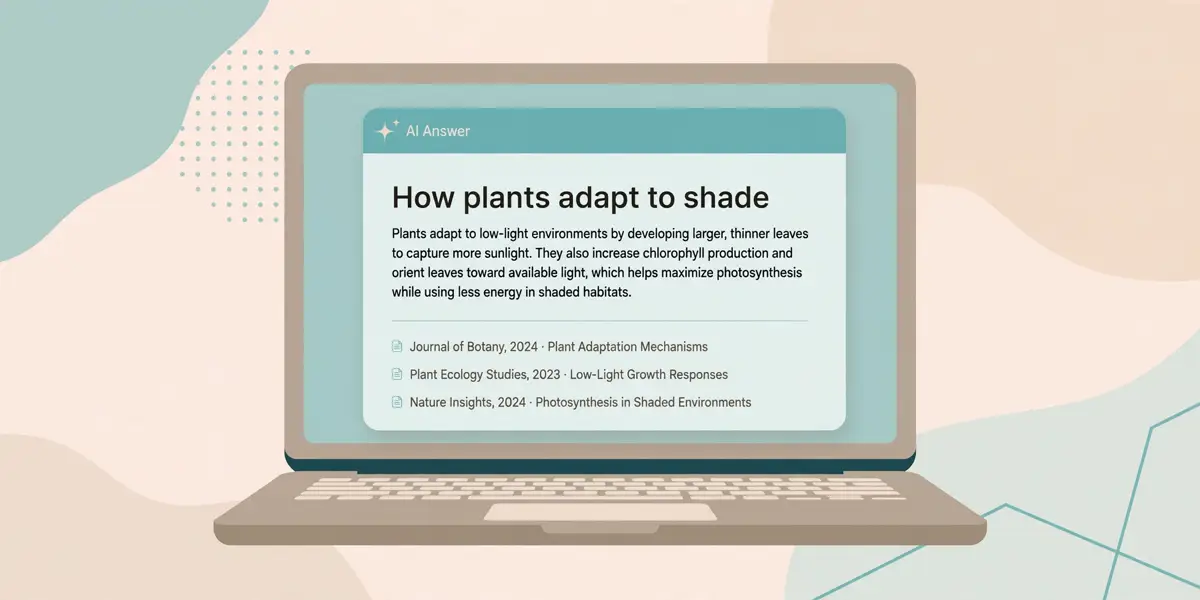
Two clarifications before the detail. First, AEO here means answer engine optimization, not the customs term "Authorised Economic Operator" — the same three letters name a completely different thing, and most of the top results for "what is AEO" are about customs, not search. Second, AEO is not a replacement for SEO and not a set of special tricks. Google's guidance puts it plainly: optimizing for generative AI search "is optimizing for the search experience, and thus still SEO", and there are "no additional requirements to appear in AI Overviews or AI Mode, nor other special optimizations necessary". AEO rests on SEO: the answer engines retrieve their sources from search indexes, so a page search cannot reach cannot be cited.
1. What AEO actually is
An answer engine is a system that answers a question in its own words and names or links its sources: ChatGPT, Perplexity, Claude, Microsoft Copilot, and Google's AI Overviews and AI Mode. The work of AEO is getting your company named, cited, and described correctly inside those answers. Three things count, and they are not the same thing. A citation is a link to a source shown with an answer. A mention is the company's name in the answer, with or without a link. And being described correctly matters as much as being cited at all: in March and April 2026, 11.0% of 98,020 atomic claims in Google AI Overviews were not supported by the pages they cited, according to a preprint study. AEO therefore includes checking what answers say about you, which SEO does not measure.
The scale is no longer small. Google said in May 2026 that AI Mode passed one billion monthly users a year after launch, and up to 67% of searches now end without a click, according to Salesforce. That is the shift AEO answers: when the answer is the destination, the citation inside it is the new form of visibility.
2. AEO vs SEO: the comparison
The two are not rivals and not the same job. The table states the difference; the paragraph after it states what they share.
| SEO | AEO | |
|---|---|---|
| Goal | A high position for a page in search results, and a click | A mention or citation in the answer, with an accurate description |
| Typical query | Short keyword phrases | Questions and longer prompts — AI summaries appeared on 60% of Google searches starting with a question word, against 8% of one- or two-word searches (Pew, March 2025) |
| Where the result appears | A ranked list of links | Inside a written answer, as a linked source or an unlinked name |
| Which pages earn it | Mostly the company's own pages | Often other sites' pages about the company — 93.5% to 95.1% of the sources ChatGPT cited in ranking-style tests were earned media |
| Off-site signals | Links | Mentions — across 75,000 brands, branded web mentions correlated with AI visibility at 0.656 to 0.709, while backlinks showed "very weak correlations" (Ahrefs vendor study; a correlation, not proof that mentions cause visibility) |
| How it is measured | Rankings, impressions, clicks, and click-through rate | Mention and citation rates across repeated runs, accuracy, and share of voice |
| Traffic | Fewer clicks when an AI summary appears — 8% of visits against 15% without one (Pew) | Small so far — ChatGPT referrals were under 0.2% of traffic across 973 e-commerce sites |
What they share is the foundation. Answer engines search before they answer, and they search indexes that crawlers build. Google says its generative AI features are "rooted in our core Search ranking and quality systems", and that to appear in AI Overviews or AI Mode a page must be indexed and eligible to be shown with a snippet. Rank carries over, too: in a NeurIPS 2025 benchmark, traditional SEO strategies were significantly more effective than rewriting the page, and in 252,000 controlled trials across six models, topical relevance and list position were the biggest drivers of which source was cited first. The shared foundation is therefore crawl access, indexing, fast and readable pages, relevance to the query, and pages that rank. Work on these serves both.
Which gap to close first depends on where you stand. If key pages are not indexed or are blocked to crawlers, work on SEO first — AI features can only show indexed, snippet-eligible pages. If pages rank but AI answers name competitors, work on AEO: answer-first pages, published prices and scope, and coverage on third-party sites. If AI answers describe the company wrongly, fix the facts on your pages and on the third-party pages the answers cite.
GEO: the synthesized multi-source answer
GEO — generative engine optimization — is the work of being included when an AI system writes an answer from several sources at once, instead of quoting one page. ChatGPT, Perplexity, Claude, and Google's AI Mode and AI Overviews all do this: they read a set of sources, combine what they say, and write one answer in their own words.
The difference from SEO and AEO is what you are trying to win. SEO wins a position for your page in a list of links on Google or Bing. AEO wins a place as the cited single source of an answer — a featured snippet, a ChatGPT answer with a citation, a Siri or Alexa reply, or a Google People Also Ask result. GEO wins a place inside a synthesized answer, where your brand or fact is one of several sources the answer draws on.
Citations are not all-or-nothing. Perplexity and Google AI Overviews show citations and links with their answers; other AI answers name a brand or use its facts without any link at all. So GEO is partly the same work as AEO — clear answers, real facts, strong brand signals — and partly different: the answer may mention you without sending you a click, so the mention itself is the visibility.
| SEO | AEO | GEO | |
|---|---|---|---|
| Goal | A high position for a page in search results, and a click | A mention or citation in the answer, with an accurate description | Inclusion in a synthesized multi-source answer |
| Where you appear | A ranked list of links | Inside a written answer, as a linked citation or a named source | Inside a written answer, as one of several sources — sometimes linked, sometimes not |
3. The word soup: AEO, GEO, AIO, and the rest
The rapid spread of AI search has produced a confusing array of new terms. The table gives the working definitions; the honest note after it is what to do with them.
| Term | Stands for | What it usually refers to |
|---|---|---|
| AEO | Answer engine optimization | The source an AI answer cites or names |
| GEO | Generative engine optimization | Being cited in AI-generated answers — Google says AEO and GEO "are both terms you may see used to describe work specifically focused on improving visibility in AI search experiences" |
| AIO | Artificial intelligence optimization | The broadest term — the AI-era equivalent of "SEO", a catch-all for all optimization aimed at AI systems |
| LLMO | Large language model optimization | Influencing how language models understand and reflect content |
Agencies have introduced new acronyms to differentiate themselves, which adds noise. But beneath the jargon, the shift is genuine: from a ranking mindset to a citation mindset. What matters is the work, not the label. This post uses AEO for the whole job and names GEO where the cited pages do. The State of Search 2027 survey gives a sense of how far the label has spread: 92% of professionals already apply at least one GEO tactic, and 43% call it a priority for 2027.
4. How an answer engine picks its sources — a worked demonstration
An answer engine does not invent its answer from nothing. It searches first, reads the top sources, writes an answer, and names the sources it used. The search it runs is not the one you typed: ChatGPT search "typically rewrites your query into one or more targeted queries", and Google says AI Overviews and AI Mode may use query fan-out, "issuing multiple related searches across subtopics and data sources". Questions are where the answers appear most: in a March–April 2026 crawl of trending queries, AI Overviews appeared for 13.7% of queries overall and 64.7% of question-form queries.
The demonstration below runs the AEO check on a real page: our own live Post 1, What Is Domain Authority and How to Check It. Ask the same four questions of your own most important page, and fix the first one that fails.
- Is the page indexed? Post 1 is indexed — our own Search Console records show it on Google, last crawled 29 October 2026. A page search cannot reach cannot be cited, so this is the first check and the one that stops everything else if it fails.
- Does it answer the question in the first sentence under the heading? Yes: "Domain authority is a third-party score that estimates how strong a website's overall link profile is." That is the sentence an answer engine can lift whole, without editing.
- Are the facts in ordinary text, not only in images? Yes: the 1–100 scale, the domain-versus-page distinction, and the warning that the score is an estimate, not a Google metric, are all in text a machine can read.
- Does it carry an FAQ section with short, complete answers? Yes — the post ends with one, marked up so the structure is explicit rather than implied.
The point of the demonstration is the check, not the page. It does not claim Post 1 is cited by any AI answer — that has not been measured, and section 7 covers how to measure it. What the check gives you is the order of work: indexing first, then the direct answer, then facts in text, then the FAQ.
Specific facts carry more weight than formatting. In the six-model trials above, an explicit price and a recent date raised the odds of being cited first in all six models, while formatting alone had no consistent effect. So state price, scope, and date plainly — and keep them true, because buyers check: in a January 2026 survey of 1,862 technology buyers, 94% of those who used AI said they fact-check its responses at least some of the time.
5. What to do on the page
The on-page work is a checklist, in order. Each step is small; the order is what makes it work.
- Put the direct answer first. One or two sentences, no hedging, in the first paragraph under the heading.
- Write headings as the questions readers ask. Clear headings make content easily quotable, and they match the question-form queries where AI answers appear most.
- Add an FAQ section with three to five real questions and short, complete answers — and mark it up with FAQ schema, so the structure is explicit rather than implied. The limit is in section 8: schema marks up what is already there, it does not create visibility.
- Keep facts in ordinary text, never only inside images. A fact that lives only in a picture cannot be quoted, and it cannot be read by a search engine either.
- State price, scope, and date plainly. An explicit price and a recent date raised the odds of being cited first in the trials above — and a page that states them can be both cited and confirmed.
- Add structured data beyond FAQ — Organization and Article where they apply, in JSON-LD format, validated with Google's Rich Results Test.
- Build one original asset per topic. AI can synthesize existing content. It cannot create original research, proprietary data, or unique tools.
- Link internally to the page that should be cited, with descriptive anchors — never "click here".
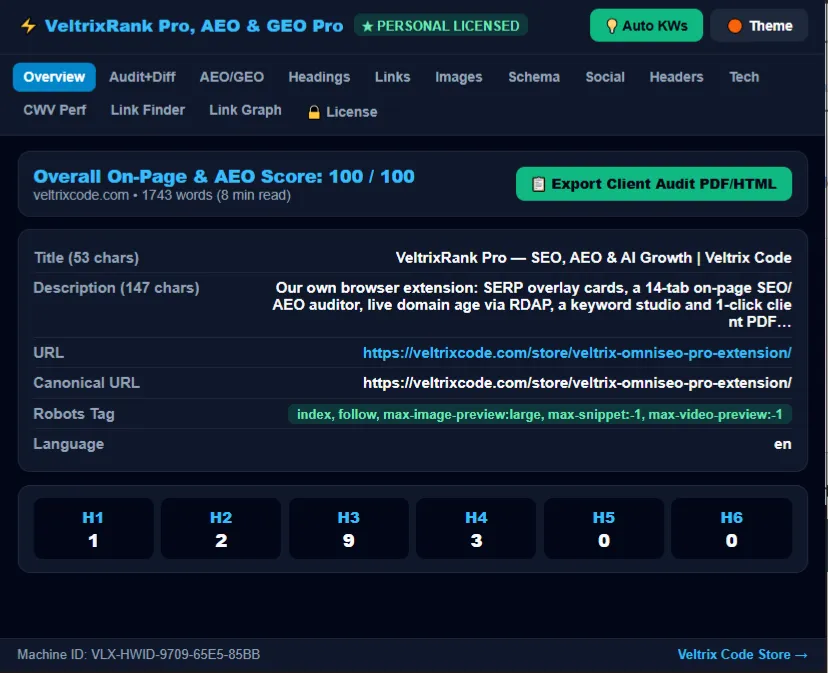
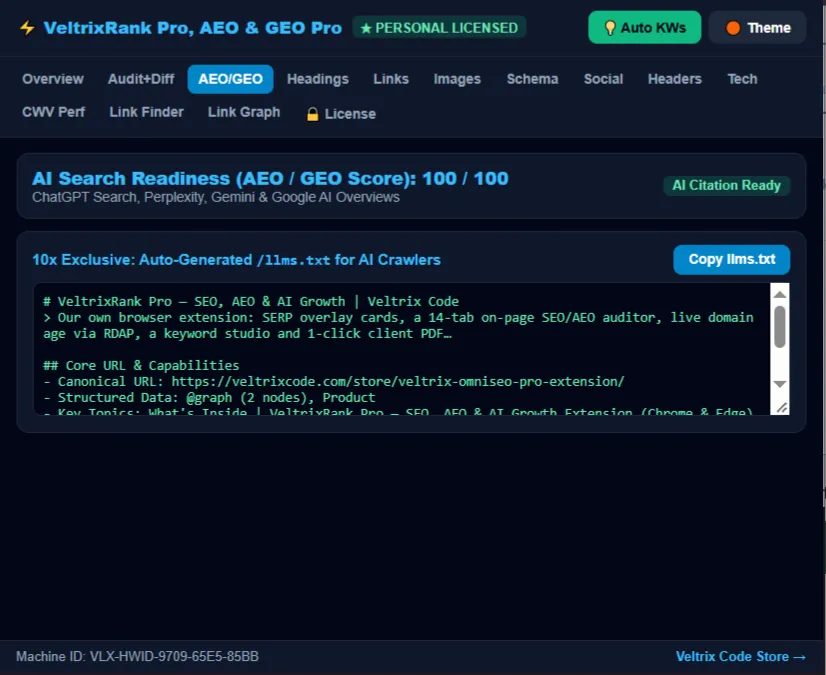
You can run these checks tab by tab with the 14-tab on-page SEO/AEO auditor in VeltrixRank Pro, which opens on any page you are auditing. The same checks, as a 30-minute workflow, are in How to Do an On-Page SEO Audit in 30 Minutes.
6. What to do off the page
Here is the finding that changes the plan: in ranking-style tests, 93.5% to 95.1% of the sources ChatGPT cited were earned media — reviews, editorial coverage, directories — and in a panel of 102 brands on five AI engines, only 2.9% of citations pointed at the brand's own domain. Your own pages are the minority of what gets cited. The sources behind an AI answer usually are not yours.
That is why mentions matter. Across 75,000 brands, branded web mentions correlated with AI visibility at 0.656 to 0.709, while backlinks showed "very weak correlations" — an Ahrefs vendor study, and a correlation, not proof that mentions cause visibility. In practice the work is: earn mentions on credible industry sites, collect genuine reviews, keep business details identical everywhere, and earn links from real sites. The backlink gap analysis shows where those links already exist — the sites that link to your competitors but not to you are the same sites an AI answer is likely to draw on.
Google's caution belongs here too: seeking inauthentic "mentions" across the web "isn't as helpful as it might seem", so the mentions have to be earned. Bought mentions and bought links are the same shortcut under two names, and the second is against search engines' rules.
Being named counts even without a link. In an audit of AI product recommendations published in September 2026, ChatGPT expressed a first-person product preference in 79% of the responses that recommended products. Buyers act on those names: in a Semrush survey, 71% said they visit a vendor's website after an AI names the vendor.

7. How to measure it
A search ranking can be checked with one query. An AI answer cannot. When 600 volunteers ran the same prompts 2,961 times, ChatGPT and Google's AI gave the same list of brands in less than 1 of 100 runs, and the API and the consumer app of the same assistant shared only 12.0% (ChatGPT) and 14.8% (Gemini) of cited domains. AEO visibility is therefore reported as the share of repeated runs that mention or cite the company, per engine — a rate, not a position.
The method, in order:
- Pick ten questions that matter — your ten most important searches, the ones your best pages already answer.
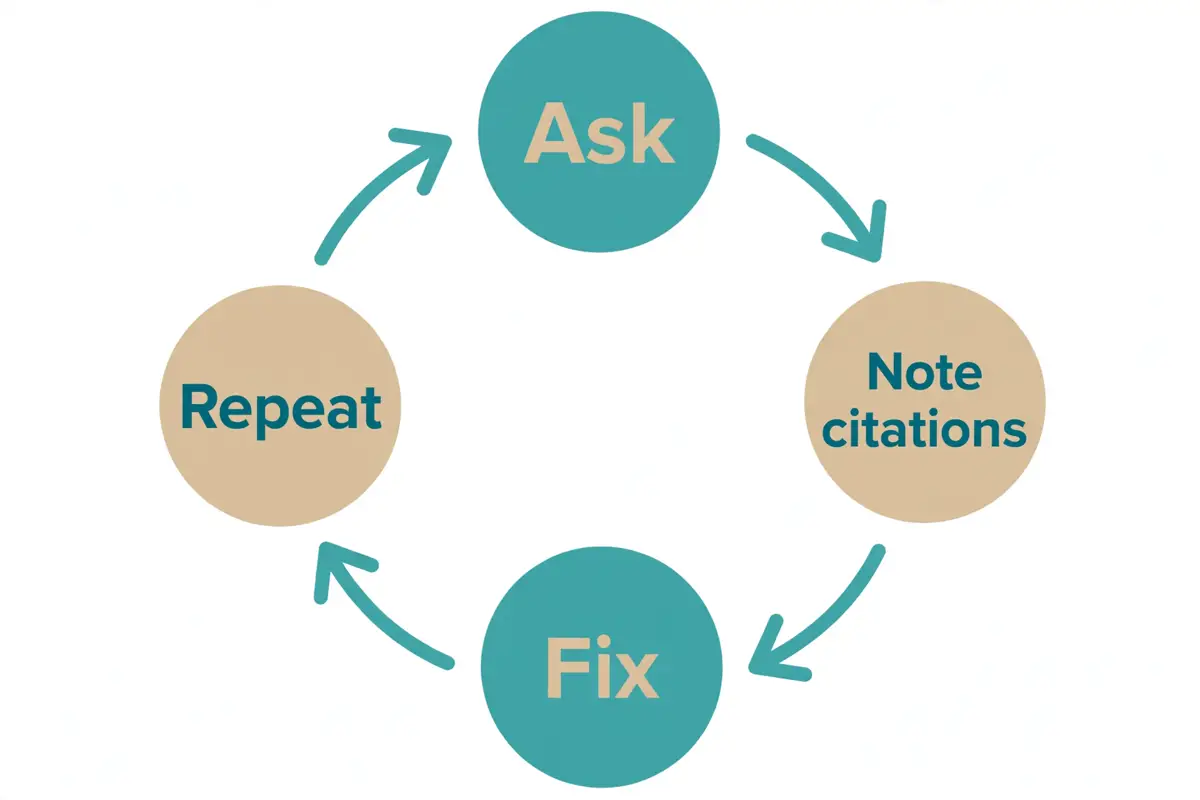
- Ask each one in each AI tool you care about, on different days, and note which pages it cites and whether it names you. One run is a snapshot; the share across runs is the signal.
- Record the share, not a single result. If you are cited in 3 of 10 runs on ChatGPT and 1 of 10 on Perplexity, that is the measurement.
- Check Search Console's generative AI report, which counts impressions in AI Overviews and AI Mode. Remember that traffic from AI Overviews and AI Mode is included in the overall "Web" search type of the Performance report, not shown separately.
- Ask new customers how they first heard about you. In one firm's records, 189 of 213 leads who answered named an AI tool, but first-touch attribution credited AI with only 28 of them. Referral data alone undercounts AI influence.
What not to measure: a single position — SparkToro estimated it takes about 1,000 runs before two brand lists appear in the same order. Click-through rate alone — users clicked a link inside the AI summary itself on 1% of visits (Pew), so the value is the mention, not the click. And ChatGPT referral traffic alone — under 0.2% of traffic across 973 e-commerce sites, and it misses visits, since some AI traffic carries no referrer at all.
Positions still matter, because rank carries over into citations. The free Veltrix SEO Rank Tracker checks keyword positions from real Google results pages, re-checks automatically every three days, and needs no licence key and no account. Track positions there, and track citations by the method above — the two together are the measurement.
8. What not to do
- Do not stuff keywords. The authors of the original GEO paper found that keyword stuffing, while "widely used for Search Engine Optimization", offered "little to no improvement on generative engine's responses".
- Do not rewrite pages to suit the engine. A NeurIPS 2025 benchmark found statistically significant ranking gains in only 3 of 54 cases when pages were rewritten for the engine, and adding statistics lowered rankings in 19 of 24 settings.
- Do not treat FAQ schema as a shortcut. FAQ rich results disappeared from Google on 7 May 2026, and schema is not an AEO shortcut — neither is llms.txt. Schema marks up what is already there; it does not create visibility.
- Do not buy mentions or links to fake corroboration. Bought links presented as editorial are against search engines' rules, and inauthentic mentions do not help either.
- Do not expect a guarantee. Bing says GEO, its term for this work, "does not guarantee grounding or citations in AI experiences", and SEO does not guarantee rankings or traffic either. Anyone selling a guaranteed citation is selling something the work cannot deliver.
- Do not abandon SEO for AEO. The foundations are the same, and the benchmark above says traditional SEO strategies beat rewriting. The 2027 outlook makes the same point: the basics matter more in 2027, not less.
Frequently asked questions
What is AEO? Answer engine optimization: the work of getting your brand named or cited inside an answer written by an AI system, such as ChatGPT, Perplexity, or Google's AI Overviews. SEO earns a ranking and a click; AEO earns a mention or a citation inside the answer itself.
How is AEO different from SEO? SEO targets a query and a results page; its success is a high position and a click. AEO targets a question and the answer written for it; its success is a mention or citation with an accurate description. They share the same foundation — crawlable, indexed, fast pages that rank — and they work best together, not as alternatives.
What is GEO, and is it different from AEO? Generative engine optimization is the work of being cited in AI-generated answers. Google says AEO and GEO "are both terms you may see used to describe work specifically focused on improving visibility in AI search experiences". In practice they share the same foundations: clear answers, real expertise, strong brand signals, and clean technical SEO.
Do I need to stop doing SEO to do AEO? No. AEO rests on SEO, because answer engines retrieve their sources from search indexes. Google's guidance says optimizing for generative AI search "is optimizing for the search experience, and thus still SEO". A page search cannot reach cannot be cited.
How do I know if my pages are cited in AI answers? Check by hand, as a rate: ask your ten most important questions in each AI tool you care about, on different days, and note the share of runs that cite or name you. Add Search Console's generative AI report, which counts impressions in AI Overviews and AI Mode, and ask new customers how they first heard about you. No tool measures citations reliably on its own, so a small manual sample beats a fabricated number.
Does AEO work for a small site? Yes — and the earned-media finding is the reason. Most citations point at other sites, not at the brand's own domain, so a small site wins by answering specific questions well and earning mentions on credible sites, not by out-spending competitors. Start with one page: run the four-question check in section 4 on it, fix the first step that fails, and measure the share of runs that cite you. There is no guarantee — no one can promise a citation — but the work is the same work that makes the page rank.
Sources
- AEO HQ, "AEO vs SEO: what is different and what is the same" — https://www.aeohq.ai/articles/seo-vs-aeo
- Salesforce, "What Is AEO? A Guide to Answer Engine Optimization" — https://www.salesforce.com/marketing/palmata/aeo/?bc=OTH
- Jives Media, "What Is AEO? Answer Engine Optimization Explained (2026)" — https://www.jivesmedia.com/services/what-is-aeo/
- Seer Interactive, "AIO Impact on Google CTR: 2026 Update" — 53 brands, 2.43 billion impressions (figures via Post 5).
- Search Engine Journal, "State of Search 2027" — professional survey figures quoted in this post (via Post 5).
Try it on your own site
The fastest way to start is the four-question check in section 4, run on your most important page. The 14-tab on-page SEO/AEO auditor in VeltrixRank Pro runs those checks tab by tab on any page you are auditing. Pro is available as a 3-day free trial, with Personal plans from $11/month and Agency plans at $89/year. Fresh-domain quotas are 3/day on trial, 15/day on Personal, and 100/day on Agency; cached domains are unlimited. Readers who want the complete toolkit will find it in VeltrixRank Supreme, the fuller 19-feature edition, Personal from $15/month and Agency at $149/year.