
A backlink is a link from another website to yours. Search engines treat links as one signal among many that a page is worth showing, and the sites that link to you — your referring domains — are part of how your site's standing is judged. That standing is what What Is Domain Authority and How to Check It explains, and this post answers the next question: where does that standing come from, and which linking sites are you missing?

A backlink gap analysis compares your referring domains with your competitors' referring domains and keeps only the difference: the domains that link to them but not to you. That difference is your prospect list. It is useful for exactly the same reason the keyword gap analysis in the previous post is useful — your competitors have already done the work of finding sites willing to link in your market, and the comparison lets you see that work instead of starting from a blank page.
1. What a backlink gap actually is
Take three lists. Your list: every domain that links to your site. Competitor A's list and competitor B's list: every domain that links to each of them. Remove from the competitors' lists every domain that already links to you. What remains is the gap — and only that remainder is the gap. Domains that link to all three of you are not gaps; they are shared links you already have. Domains that link only to you are not gaps either; they are your existing advantage.
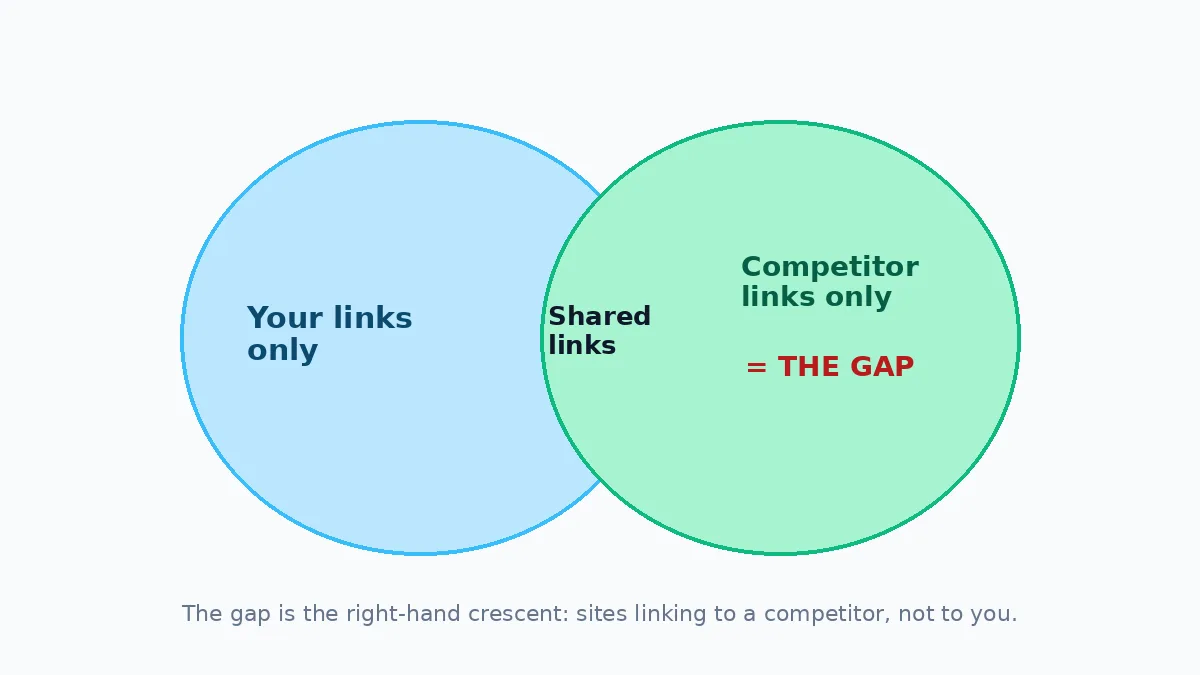
Two distinctions keep the analysis honest. First, a gap is measured in referring domains, not in total links: one domain linking fifty times is still one domain. Second, a gap says nothing about quality on its own — a relevant directory and an unrelated site that links to everyone are both gaps by the arithmetic, but only one is worth pursuing. The filtering step below exists for exactly that reason.
2. What a backlink gap is not
A gap list is not a list of links you own, links you are owed, or links a tool has verified. Most backlink tools work from estimates: they crawl part of the web, they miss links, and they count links your own data does not show. Their figures are useful for prospecting, but they are not measured facts about your site. Your own measured data is the Links report in Google Search Console for your own verified property — the sites Google actually found linking to you — and that report is where your side of the comparison should start.
The same honesty applies to this site's own tooling. The backlink gap tab in VeltrixRank Supreme compares authority estimates across your domain and two competitors, and lists generic citation hubs — directories, review sites, publications — as outreach suggestions. Those hubs are suggestions, not verified competitor links: the tool itself says they were not verified as linking to your competitors. Use the tab for ideas, then verify each prospect yourself. A list labelled verified when it is not would be worse than no list, because every outreach message after it would rest on a claim you cannot defend.
Finally, a gap is not a ranking promise. Links are one signal among many, and a page still has to deserve its ranking with content that answers the search. Anyone who sells a gap list with a ranking guarantee attached is selling something the list cannot deliver.
3. A worked example, step by step
The example below uses fictional domains, labelled as such, so no real site is claimed to link to anyone. The numbers are small on purpose: a real analysis has longer lists, but the operations are identical — list, compare, subtract, filter.
Imagine a fictional bakery, example-bakery.test, against two fictional rivals, rival-oven.test and rival-cakes.test. Its own referring domains, from its Search Console Links report, are a local food blog, a neighbourhood directory, and a supplier's stockist page. Rival-oven's are the same food blog, a city restaurant guide, and a recipe site. Rival-cakes' are the same food blog, the same city guide, and a wedding-planning blog.
| Domain | Links to you | Links to rival-oven | Links to rival-cakes |
|---|---|---|---|
| Local food blog (fictional) | Yes | Yes | Yes |
| Neighbourhood directory (fictional) | Yes | No | No |
| Supplier stockist page (fictional) | Yes | No | No |
| City restaurant guide (fictional) | No | Yes | Yes |
| Recipe site (fictional) | No | Yes | No |
| Wedding-planning blog (fictional) | No | No | Yes |
Subtract what you already have. The food blog, the directory, and the supplier page drop out — the first is shared, the other two are already yours. Three domains remain, and they are the gap: the city restaurant guide, the recipe site, and the wedding-planning blog. The city guide is the strongest prospect, because both competitors have it — two independent sites found it worth a listing, a stronger signal than a single competitor's link.
Then filter. The bakery does not do wedding cakes, so the wedding-planning blog, while a real gap by the arithmetic, is not a real prospect — its readers are not the bakery's readers. The surviving shortlist is two prospects long: the city restaurant guide first, the recipe site second. That is the whole discipline: most of the work is not generating the list, it is deleting from it. Two genuine prospects beat an export of two hundred unfiltered domains, because the two can actually be acted on.
4. Run it on your own site, step by step
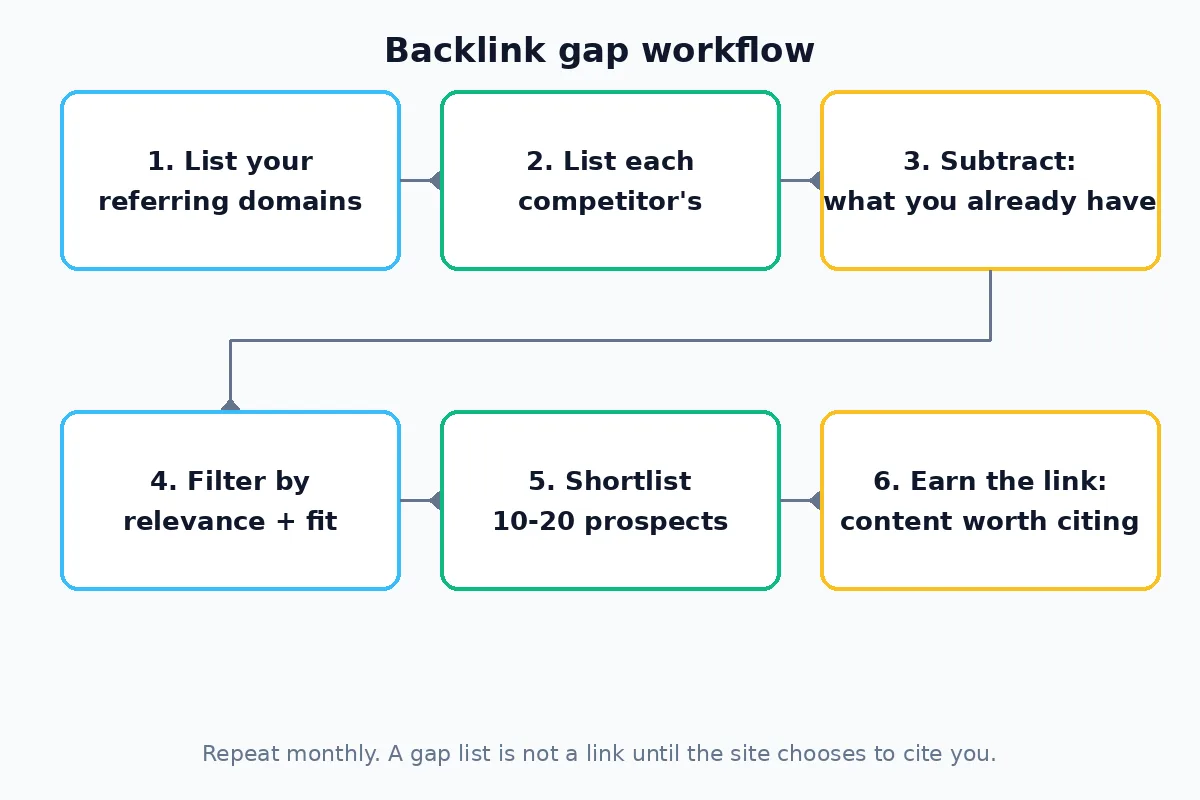
The workflow is the same whatever tool you use, and it follows the order of the worked example:
- Open Google Search Console for your own verified property and export your referring domains from the Links report. This is your baseline list, and it is the only list in the analysis that comes from measured data about your own site.
- Choose two or three search competitors — the domains that actually appear for your target searches, as in the keyword gap post, not necessarily your business rivals. Two or three are enough for a first analysis.
- Get each competitor's referring-domain list from a backlink tool. Treat every figure on these lists as an estimate: the tool's crawl is partial, and a domain it shows may not link to the competitor in the way the summary suggests. Open the linking page and check before you count it.
- Subtract: remove every domain that already links to you, and remove duplicates so each domain is counted once, however many times it links.
- Filter what remains by relevance, fit, and shared competitors (see the next section), and keep a shortlist of 10–20 prospects you can actually act on.
- For each shortlisted prospect, decide the one action that could earn the link — a better page, a listing request, a correction, or a genuine contribution — and record it, so the same list is not re-examined from scratch next month.
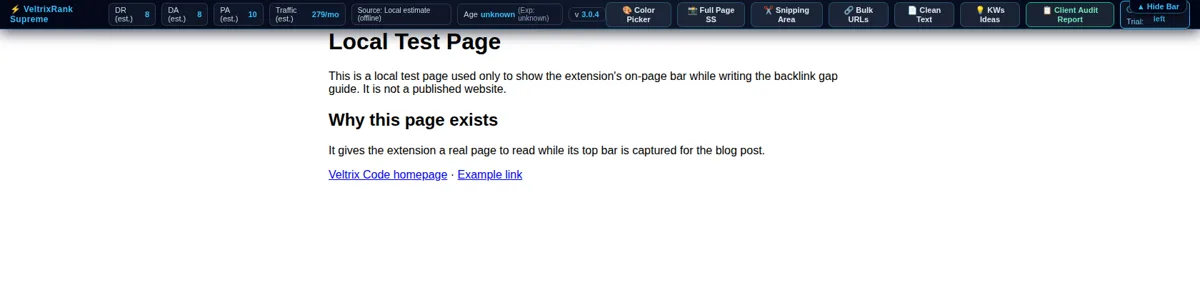
Open the extension on any page you are auditing and its on-page bar appears at the top, showing the page's authority estimates and its tools. The screenshot below is a real capture of that bar on a local test page, taken while writing this post, and its figures are the extension's offline estimates for that test page — not data about any published site.
You can run the comparison with the backlink tools in VeltrixRank Pro, and the gap finder with its disavow generator is described on the VeltrixRank Supreme page. Remember the honesty rule from section 2: a suggestion list is a starting point for verification, not a verified gap list, and the Search Console export stays your baseline. VeltrixRank Pro is available as a 3-day free trial, with Personal plans from $11/month and Agency plans at $89/year. Fresh-domain quotas are 3/day on trial, 15/day on Personal, and 100/day on Agency; cached domains are unlimited.
5. How to prioritise the gap list
A gap list always contains more domains than you can approach. Prioritise by four questions, in this order:
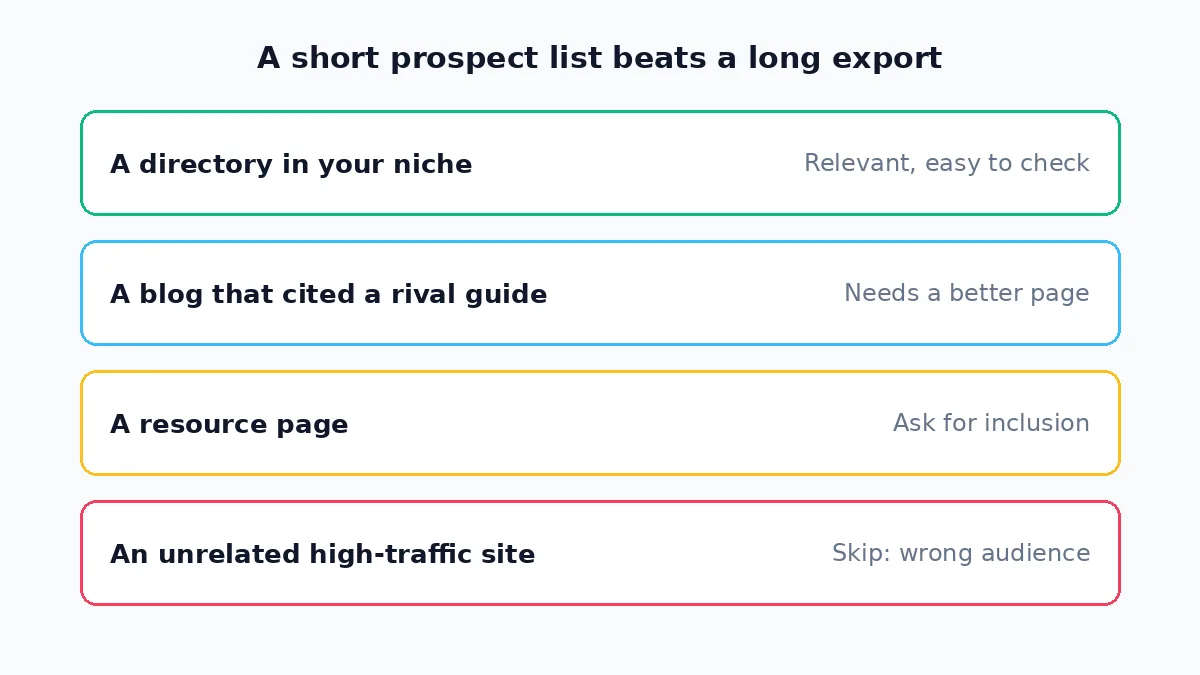
Is it relevant to what you actually do? A prospect whose audience could plausibly become your reader or customer is worth approaching. A high-traffic site in an unrelated subject is someone else's audience, and a link there dilutes what your site is about.
Do several competitors share it? A domain linking to two or three competitors is a stronger, more proven prospect than one linking to a single competitor, and more likely a genuine editorial or directory listing than a one-off favour.
Can you offer something worth linking to? A prospect that links to a competitor's guide or data will only link to you if you have something comparable or better. If you cannot name, in one sentence, what page deserves the link, build the page first.
Is the link actually attainable? A resource page with a submission form, a directory with a listing process, and a blog that regularly cites sources are attainable. A competitor's partner page, a paid placement dressed as editorial, and a site that never links out are not. Note them and move on.
6. How to earn the link
There are only a few honest ways a gap prospect becomes a linking site, and they all start from something the prospect would want to cite:
- Be the better page on the topic. If the prospect links to a competitor's guide, publish a guide that covers it more completely or more recently — then tell the prospect, once, what is new. The link follows the page, not the pitch.
- Ask for a listing where listings are the point. Directories, resource pages, and roundups exist to list relevant sites. A short, factual listing request is normal, and the one case where asking directly is the whole method.
- Offer a genuine correction or addition. If a prospect's page links to a moved or outdated resource on your topic, pointing that out — with your page as the replacement — helps the prospect's readers, which is why it works.
- Contribute something original. Original data, a worked example, a clear diagram, or a tool the prospect's readers can use gives a site a reason to cite you that no pitch email can manufacture.
What earns links, in every case, is the page behind the request. Outreach without a page worth citing is just an email asking for a favour. Build the page first, approach second, and keep the message short: what your page adds, and where it would fit on theirs.
7. What not to do
Three shortcuts will cost more than they gain:
- Do not buy links to close a gap. Paid links presented as editorial are against search engines' rules, and a link bought to imitate a competitor's profile is the easiest kind of link to lose — or to be penalised for — later. A gap closed by payment is not a gap closed.
- Do not send mass outreach. The same templated message to every domain on an unfiltered export is how a site earns a reputation for spam, and it burns the few prospects that were actually worth approaching. Ten personal messages beat a thousand templated ones.
- Do not disavow a gap prospect. A gap domain is a site you want a link from, not a site you want to distance yourself from. Disavowal is a separate tool for a separate problem, and confusing the two can remove links you actually wanted.
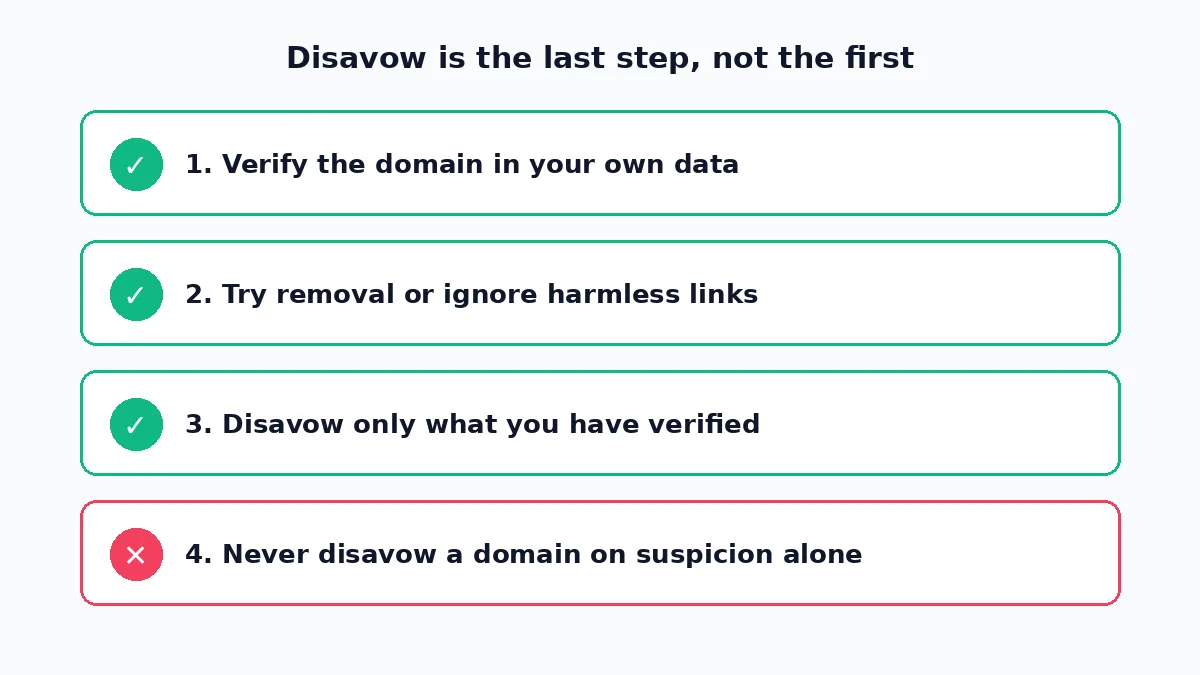
On disavowal specifically: only consider it for domains in your own backlink data that you have verified as harmful — for example, links you paid for in the past, or links from clearly manipulative schemes — and only after considering removal requests and leaving harmless links alone. A wrong disavow can harm rankings, which is why the Supreme tool's disavow generator starts from an empty list you fill yourself, not from any automatic suggestion.
Backlink gaps, keyword gaps, and backlink audits compared
Three analyses share vocabulary and are easy to confuse. They answer different questions, and running the wrong one wastes the month:
| Analysis | Question it answers | What you do next |
|---|---|---|
| Keyword gap | Which searches do competitors rank for that you do not? | Write or improve a page for each kept keyword |
| Backlink gap | Which sites link to competitors but not to you? | Earn a link from each shortlisted prospect |
| Backlink audit | Which of your own links are harmful or worthless? | Request removal, or disavow only what you verified |
Run them in that order for a new site: find what to write about, find who might cite it, and only then review your own links.
Frequently asked questions
What is a backlink gap? A backlink gap is a domain that links to at least one of your competitors but does not link to your site. Finding it means comparing referring-domain lists and keeping only the domains you do not already have.
Where do I get my own backlink list? Start with the Links report in Google Search Console for your own verified property, because that is your own measured data. Tool estimates can add prospects, but they do not replace your own list.
How is a backlink gap different from a keyword gap? A keyword gap is about searches: terms competitors rank for that you do not. A backlink gap is about links: sites that link to competitors but not to you. One leads to new content, the other leads to outreach and pages worth citing.
How many competitors should I compare against? Two or three search competitors are enough for a first analysis. More competitors widen the list, but they also widen the noise, so add more only once you have worked through the first shortlist.
Should I disavow every domain in the gap list? No. A gap domain is a prospect, not a threat. Disavow only domains you have verified from your own backlink data as harmful, and only after considering removal or simply leaving harmless links alone.
How often should I run a backlink gap analysis? Monthly is enough for most sites. Links are earned slowly, and each outreach round needs time before the next analysis can fairly judge what worked.
Try it on your own site
The fastest way to understand backlink gaps is to run one comparison: your domain's referring domains against two search competitors, filtered to the domains you do not already have. VeltrixRank Pro includes backlink tools alongside its authority score, keyword gap tool, rank tracking, and a 14-tab on-page SEO/AEO auditor. The extension is available as a 3-day free trial, with Personal plans from $11/month and Agency plans at $89/year.
Find your backlink gaps with VeltrixRank Pro
You can also explore everything else Veltrix Code offers.